
What to Wear for a Maternity Beach Photoshoot (A Photographer's Guide)
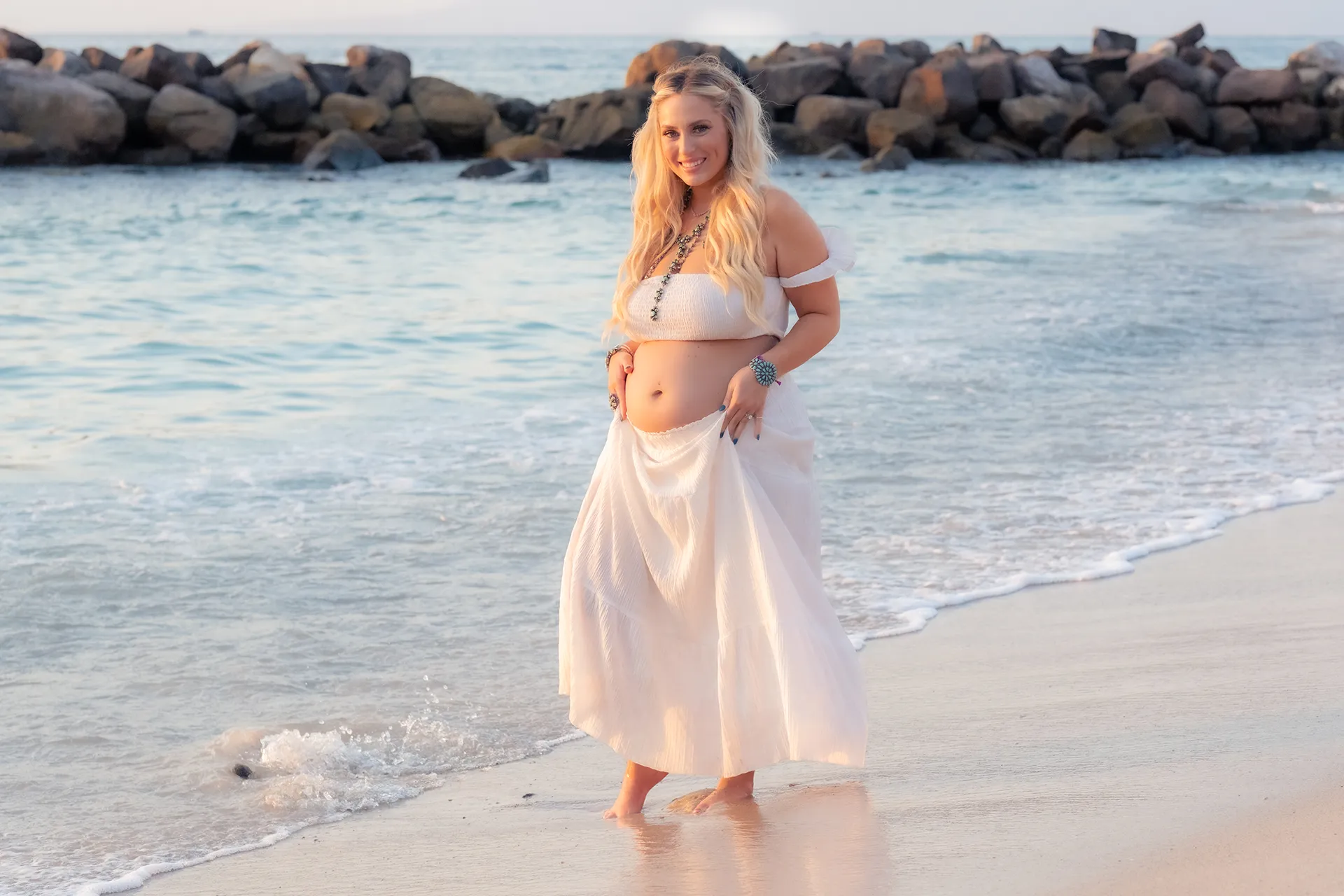
You booked the session. You found the beach. And now you’re standing in front of a closet — or three open tabs of maternity dresses — wondering which one is going to look like you in a photograph, and not like a costume.
Here’s the honest answer after decades of watching fabric meet ocean wind: what you wear matters less than how it moves. That single idea will guide almost every decision below.
The one rule that matters most: choose fabric that moves
On a beach, there is always wind. Not sometimes — always. Coastal air moves even on the stillest evenings, and that movement is the single most flattering thing available to you for free.
A dress that catches air does three things at once: it traces the shape of your bump instead of hiding it, it adds motion to an otherwise static portrait, and it gives you something to do with your hands. A stiff dress does none of that. It just sits there, and so do you.
Fabrics that move: chiffon, silk, jersey knit, tulle, gauze, lightweight cotton, anything with a long train or trailing panels. Fabrics that fight you: structured denim, heavy linen (it wrinkles the moment you sit), thick brocade, anything with boning or an internal corset.
If you buy only one thing for this session, buy the flowy dress. Everything else on this list is optional.
Colors that work in coastal light — and why
Beach light is not neutral. Near the water, everything you wear is being lit from three directions: the sun, the reflected sky, and the sand bouncing warm light up at you from below. Late in the day, that light turns gold, and gold light does specific things to specific colors.
These reliably work:****
- Cream, ivory, oatmeal, soft white — glow in warm light without competing with the sky
- Blush, dusty rose, terracotta, rust — pick up sunset tones and read as warm on any skin
- Sage, dusty blue, muted teal — sit beside the ocean instead of shouting over it
- Deep jewel tones (emerald, burgundy, navy) — for drama and contrast, especially if you want something more editorial than ethereal
These fight the light:****
- Neon anything — reflects colored light onto your own face, and it’s very hard to fix later
- Pure stark white — the brightest thing on a beach is already the sky; stark white competes with it and loses detail in the highlights
- Busy patterns, stripes, logos — the eye goes to the pattern instead of your face and your bump
- Head-to-toe black — beautiful in a studio, but on a bright beach it becomes a silhouette with no texture
The simplest test: hold the dress next to a photo of the beach you’re shooting on. If it disappears into the scene, that’s good. If it jumps out of it, think twice.
Silhouette: show the bump, don’t hide it
This is where most people get it wrong, and understandably. The instinct late in pregnancy is to reach for something loose and comfortable. But loose fabric across the belly reads as volume , not as pregnancy — the camera flattens everything, and a tent dress makes a bump disappear into the drape.
What works:
- Fitted through the bump, flowing below. Empire waist, wrap dresses, anything with a defined line under the chest and freedom underneath.
- Bodycon knit if you want something sculptural and modern — it reads as strong and intentional, not casual.
- Off-shoulder or one-shoulder to open up the neckline and collarbones, which balances the visual weight of the belly.
- Long over short. Floor-length gives the wind something to work with. Short hems on a beach mostly just create a wardrobe problem.
If you’re not sure how a silhouette will translate to a photo, look at maternity poses that actually work on the beach — how you’ll be standing changes what a dress does.
The layering trick: two looks, one session
Wear a fitted underlayer — a simple slip dress, a bodysuit, a bandeau and skirt — and bring one flowing overlayer: a robe, a duster, an open kimono, a length of tulle.
You now have two completely different sets of images without a wardrobe change on a beach where there is nowhere to change. The overlayer gives you the wind-catching, cinematic frames. Take it off and the fitted layer gives you the intimate, sculptural ones. It’s the highest-value trick on this entire list.
What partners and older kids should wear
The most common mistake: matching. Identical white shirts and khaki shorts look like a uniform, and — more importantly — they pull attention evenly across everyone in the frame. This session is about you.
Instead, complement : pull two or three colors from your dress and dress everyone else within that range, in different pieces. If you’re in cream, your partner is in a soft oatmeal linen shirt and warm beige; your toddler is in sage. Nobody matches, everybody belongs.
A rule that has never once failed me: dress the person in the photo who is not pregnant more simply than you would think necessary. Solid colors, no logos, no bright white sneakers — sneakers are the single most common thing that ruins an otherwise beautiful beach frame. Barefoot, always, if the ground allows it. If you want more detail on coordinating a group, the styling guide for couples and families goes deeper.
The practical things nobody tells you
Tan lines. This is the one that catches babymoon travelers off guard. If you’re shooting toward the end of a beach vacation and you plan to wear anything off-shoulder or strapless, swimsuit lines will show — and they photograph as sharp, distracting edges across your shoulders and back. Two options: schedule the session in the first day or two of the trip, or swim in something with a similar neckline to your dress. (If you’re weighing how much beach time to plan around your session, this guide on swimming safely while pregnant covers the Banderas Bay side of that question.)
Undergarments. Seamless and nude-to-your-skin, or nothing at all under a lined dress. Visible straps under a flowing gown are the most common retouch request I get, and it’s an entirely avoidable one.
Shoes. Barefoot photographs better than any shoe on sand — it’s more elegant, it’s more comfortable, and heels sink. Bring sandals for walking to and from the location, and take them off when we start.
Sizing and timing. Order two to three weeks ahead, and size for the week of the session, not the week you order. Pregnancy is not a stable measurement. Anything that arrives the day before is a gamble you don’t need.
Bring two outfits, maximum. More than two and you spend the golden hour changing instead of shooting. The light does not wait for anyone — the golden hour is genuinely short, and the best frames tend to happen in its last fifteen minutes.
Wrinkles. Anything folded in a suitcase for a week will arrive creased. Hang it in the bathroom during a hot shower the morning of the session. Linen is the worst offender here, which is the real reason it’s on the “fights you” list.
Your face. Whatever you wear, it will lose to your skin in a photograph. If you’re planning makeup, this guide on makeup that actually photographs well will do more for your images than any dress on this list.
The 4 mistakes to avoid
- Buying stiff. A dress that photographs beautifully on a hanger and does nothing in the wind is the most common expensive mistake.
- Hiding the bump under volume. Loose reads as bulk, not as pregnancy. Fitted-then-flowing beats loose every time.
- Dressing the whole group in the same thing. Coordinate, don’t match — otherwise nobody is the subject.
- Buying the day before. Sizing changes, packages don’t arrive, and wrinkles don’t drop out overnight.
Quick answers
What’s the best color for a maternity beach photoshoot? Soft neutrals (cream, ivory, oatmeal) and warm earth tones (blush, terracotta, rust) work in almost any coastal light. Sage and dusty blue sit beautifully next to the ocean. Avoid neon, stark white, busy patterns, and head-to-toe black.
Should my dress be tight or loose? Fitted through the bump and flowing below. Loose fabric across the belly hides the shape instead of showing it — the camera flattens volume, so a defined line under the chest is what makes the bump read.
What should my partner wear? Something simpler than you’d expect, in colors pulled from your palette but not identical to yours. Solid, soft, no logos, no bright sneakers. Barefoot when possible.
How many outfits should I bring to a beach maternity session? Two at most, or one fitted layer plus a flowing overlayer — which gives you two looks with no change at all. Beaches rarely have anywhere to change, and time spent changing is time taken from the best light.
Do I need to buy a special maternity gown? No. A flowing non-maternity dress with an empire waist or a wrap silhouette often works better than a purpose-made maternity gown, and you’ll wear it again. What matters is that it moves and that it defines the bump.
A note on where you’re shooting
Everything above is universal — it applies to any coastline. But the specific character of your beach does change the details, and it’s worth asking your photographer about the one you’ll be on.
Here in Puerto Vallarta, we shoot inside Banderas Bay, which is unusually sheltered compared to an open Pacific coast. That has a practical consequence for wardrobe: our wind is consistent but gentle, which means light fabrics float rather than whip — a length of tulle behaves like a ribbon here in a way it simply won’t on an exposed shore. It also means the water’s edge stays calm enough to actually stand in, so hems getting wet is a choice rather than an accident. If you’re shooting somewhere with heavier surf, plan for shorter, more controlled fabric and less time near the waterline.
That’s the kind of thing worth a five-minute conversation with whoever is behind the camera, wherever you are.
Planning a maternity or babymoon session in Puerto Vallarta? I’ll walk you through wardrobe, timing, and location before we ever pick up a camera — it’s part of every session. See session packages →